 MarceloBlog
Can AI Do Content Marketing?

Yes—AI can help with content marketing, including brainstorming topics, outlining articles, drafting copy and adapting approved material for different formats. But generating words is not the same as running a content marketing strategy. Useful content still needs a clear audience, accurate information, a relevant purpose and someone responsible for reviewing it before publication.
The practical approach is to give AI a defined job within a human-led process. Use it to explore and develop ideas, not to invent the facts your business needs to earn a reader’s trust.
What parts of content marketing can AI help with?
Rather than asking AI to “do our content marketing,” break the work into specific tasks. Each task should have a clear input, a useful output and a review step.
Turning customer questions into content ideas

Start with questions your customers actually ask. These might concern choosing a service, understanding a process or preparing for a conversation with your business.
Ask AI to organize those questions into possible articles, website sections or social posts. Treat the suggestions as candidates, not proof of customer demand. Before choosing a topic, ask whether it addresses a real question and whether your business has enough confirmed information to answer it well.
Building an outline
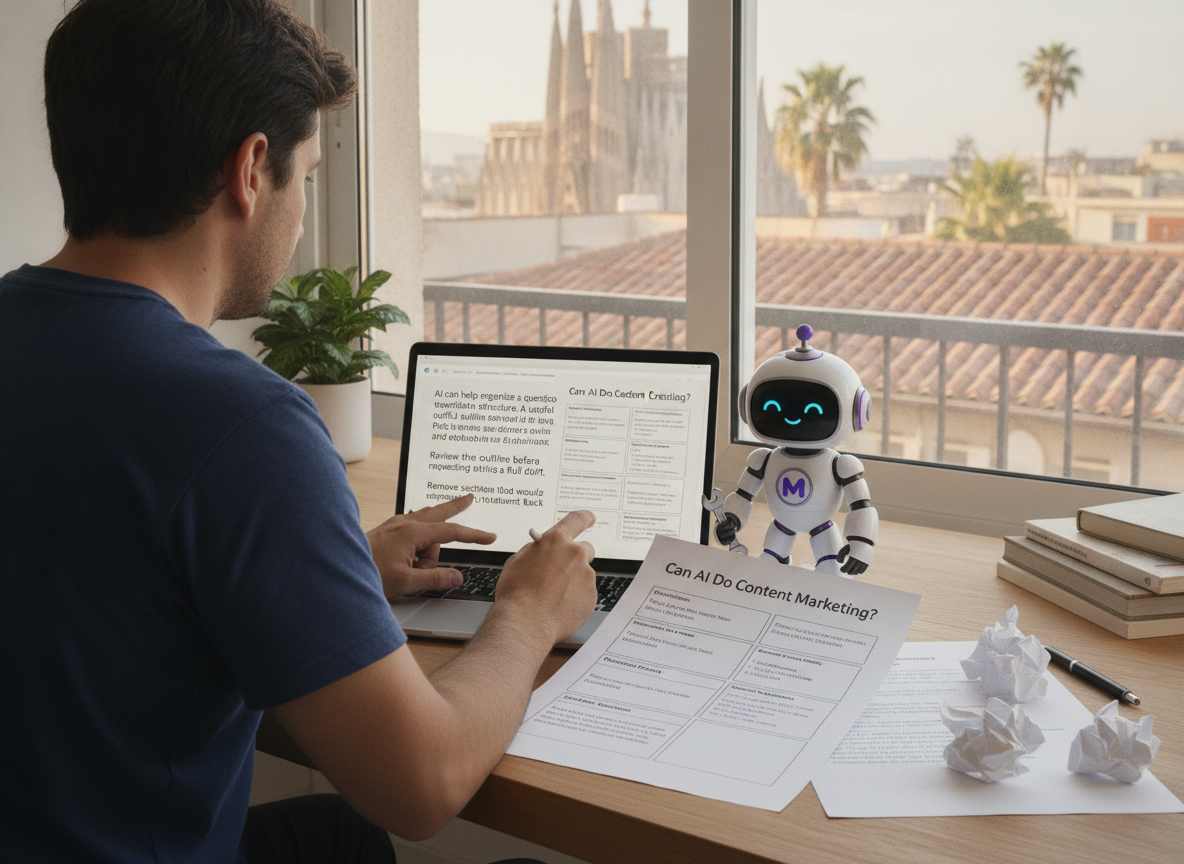
AI can help organize a question into a readable structure. A useful outline usually puts the direct answer first, followed by explanations, decision points and related questions.
Review the outline before requesting a full draft. Remove sections that would require unsupported claims, irrelevant background or information you do not have.
Producing a first draft
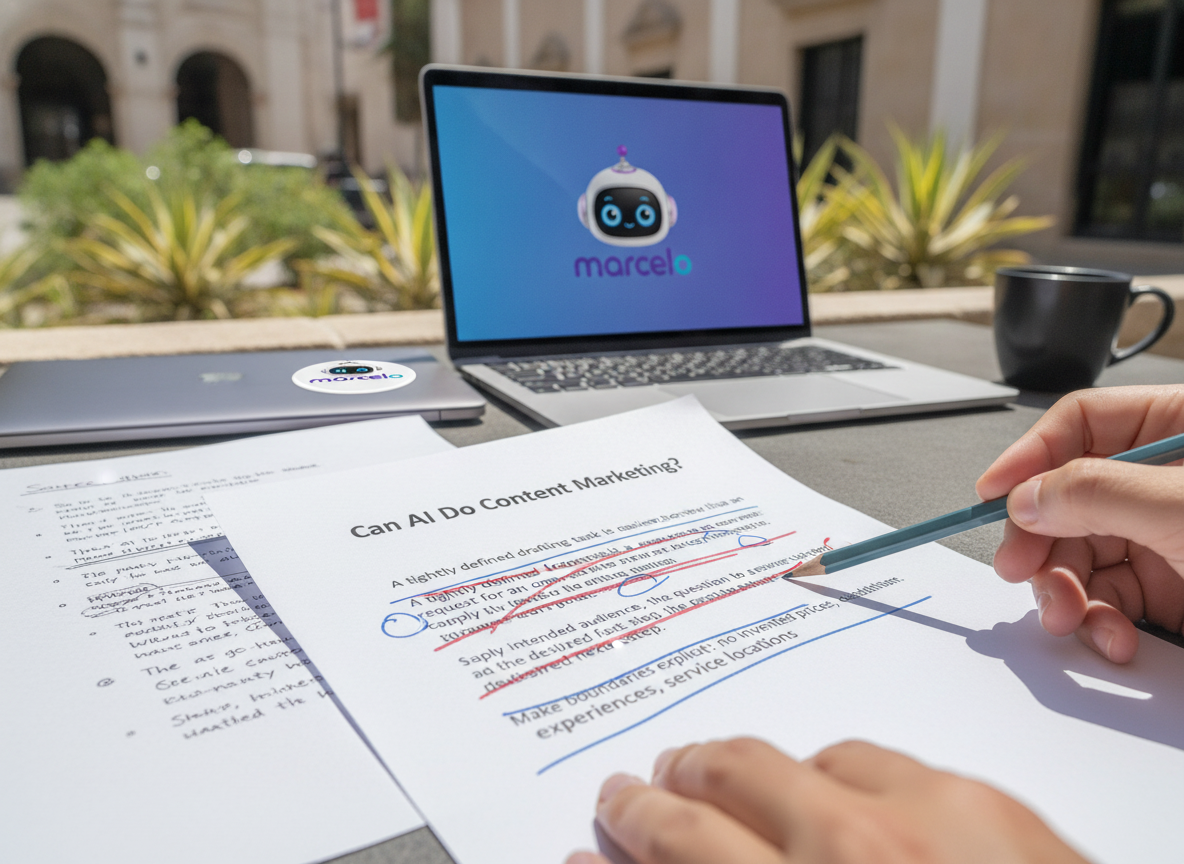
A tightly defined drafting task is easier to review than an open-ended request for an entire campaign. Supply the intended audience, the question to answer, the confirmed facts and the desired next step.
Make the boundaries explicit: no invented prices, credentials, customer experiences, service locations or promises. Even with those instructions, check the resulting draft carefully.
Editing and repurposing approved material

AI can also help shorten paragraphs, suggest clearer headings or turn an approved article into shorter pieces.
Keep the original meaning intact. A social post should not turn a qualified explanation into an absolute promise, and a summary should not introduce a service that the original article never mentioned.
What should a person remain responsible for?
Keep human approval in charge of the decisions that define what the business says and why it says it.
Audience and purpose. Decide who the content is for and what question it should resolve. “Publish something about our industry” is less useful than a specific customer problem.
Business facts. Verify service descriptions, contact details, locations, qualifications, prices and any other statements about the company against approved records.
Evidence and examples. Check every quotation, statistic and customer story. Do not treat an AI-generated example as a real event or an invented testimonial as customer feedback.
Judgment and tone. Read for more than grammar. Consider whether the advice is appropriate, whether important qualifications remain visible and whether the language reflects how the business wants to communicate.
Publication. Assign someone to approve the final version. A polished draft is still a draft until it has passed that review.
How can you give AI a useful content brief?
A strong brief separates what is known from what the writing should accomplish. Include these elements:
The reader:
Who needs the answer?
The exact question:
What should the reader understand after finishing?
The approved facts:
Which business details may appear?
The scope:
What belongs in this piece, and what should stay out?
The format:
Is this an article, service page, email or social post?
The next step:
What action makes sense after the answer?
The review requirements:
Which claims need checking before publication?
For example, a drafting instruction could be:
Answer the customer’s question directly. Use the supplied business facts without adding claims about locations, experience, prices or results. Organize the explanation around practical questions. Keep the next step relevant to the topic.
A prompt like this establishes useful limits. It does not replace the final fact-check.
What does a practical AI-assisted content workflow look like?
1. Choose one real question
Begin with a question narrow enough to answer thoroughly. If a proposed article contains several unrelated customer needs, separate them rather than forcing them into one page.
2. Gather the approved information
Collect the facts and source material before drafting. Keep confirmed business details separate from ideas, assumptions and material that still needs verification.
If a detail is not approved, leave it out of the publication draft rather than asking AI to fill the gap.
3. Set the article’s purpose
Decide what the reader should be able to understand or do afterward. That purpose should guide the structure—not a target word count or a desire to repeat a keyword.
4. Draft and review in stages
Review the outline first, then the full draft. During editing, make separate passes for factual accuracy, usefulness and readability. Separating those checks helps keep a smooth writing style from distracting attention from an unsupported claim.
5. Publish only the approved version
Check headings, links, contact information and calls to action as part of the final review. Confirm that the version being published is the version that was approved.
6. Revisit the content
Include published content in an ongoing review process. Check whether its business details remain accurate and whether it still answers the intended question clearly.
How should you judge whether AI-assisted content is useful?
Judge the finished work by its value to the reader, not by how quickly it was generated.
Before publishing, ask:
- Does the opening answer the main question?
- Does each section add something useful?
- Are statements about the business supported by approved facts?
- Are recommendations specific enough to act on?
- Have repetition and unnecessary background been removed?
- Does the next step fit the reader’s needs?
A longer article is not automatically a better one. If a paragraph adds neither an explanation nor a practical decision point, consider cutting it.
How does content marketing fit with Marcelo’s services?
Marcelo offers content marketing, search engine optimization, social media management, website design, paid advertising and marketing strategy.
When discussing content marketing with Marcelo, start with the customer question you want to answer and the information you can provide. Then identify where the content belongs and what other marketing needs you want to discuss. An article, a website page and a set of social posts should each have a defined purpose rather than simply repeating the same copy.
To discuss your content marketing needs, email support@meetmarcelo.ai.
Frequently Asked Questions
Can AI do content marketing on its own?
AI can assist with individual tasks, but keep a person responsible for strategy, factual approval and publication. Producing a draft does not establish that its claims are accurate or its advice is appropriate.
Should you publish an AI draft without editing it?
No. Review the facts, meaning, structure and next step before publishing. Check every business-specific claim against approved information.
Can one article become several social posts?
Yes. Use the approved article as the source, then review each shorter version separately. Preserve qualifications and avoid introducing new claims while shortening the text.
Does AI-written content guarantee search rankings or AI citations?
No. Do not treat using AI, publishing an article or changing its wording as a guarantee of rankings, citations or recommendations.
What is a sensible first step?
Choose one genuine customer question, gather the confirmed facts and create a brief. Use AI for a defined drafting task, then review the result before expanding the process.