 MarceloBlog
Can AI Do Paid Advertising? A Practical Guide to What to Delegate

Yes—AI can help with paid advertising, including developing campaign ideas, drafting ad copy and interpreting performance information. But generating an ad is not the same as running an effective campaign. The offer, audience, budget, destination page and definition of success still need clear direction and review.
The useful question is not simply whether AI can do advertising. It is which tasks to delegate, what information to provide and which decisions to keep under human control.
Marcelo offers paid advertising alongside marketing strategy, website design, search engine optimization, content marketing and social media management. This guide explains how to think about AI-assisted advertising and how to evaluate a proposed approach before committing a budget.
What Does “AI Doing Paid Advertising” Actually Mean?
Separate the work into three categories:
Assistance:
Using AI to suggest campaign themes, draft headlines or summarize information you provide.
Automation:
Allowing a connected advertising tool to carry out defined actions, subject to its available features and permissions.
Accountability:
Deciding what the business should advertise, what it can truthfully promise and how much it should spend.
These are different responsibilities. A tool that writes persuasive copy does not necessarily have access to an advertising account. A tool with account access should not automatically have permission to change every setting.
Before adopting any workflow, ask: Is this tool making a suggestion, preparing a change for approval or taking action with real money?
Which Paid Advertising Tasks Can AI Help With?
Consider using AI for bounded tasks with clear inputs and reviewable outputs.
Developing campaign ideas

Start with an approved service description and a specific campaign objective. Ask for several ways to explain the same offer rather than asking AI to invent a better offer.
For example, you might request three campaign angles: one focused on the customer's question, one on the service being offered and one on the next step. Review each against what the business can actually deliver.
Drafting ad copy

AI can produce alternative headlines, descriptions and calls to action. Treat those outputs as drafts, not as verified business statements.
A useful prompt is:
Using only the approved information below, draft three ad variations. Do not add prices, guarantees, credentials, locations or performance claims. Give each variation a different emphasis while keeping the offer unchanged.
Then check the copy line by line. Pay particular attention to strong-sounding phrases such as “best,” “guaranteed,” “instant” or “available everywhere.” Do not publish a claim merely because it sounds natural in an advertisement.
Reviewing the path after the click

Use AI to help compare an ad draft with its proposed destination page. Ask whether both describe the same service, make the same offer and invite a compatible next step.
Review the comparison yourself. The goal is a coherent customer experience—not simply a more persuasive headline.
Summarizing campaign information
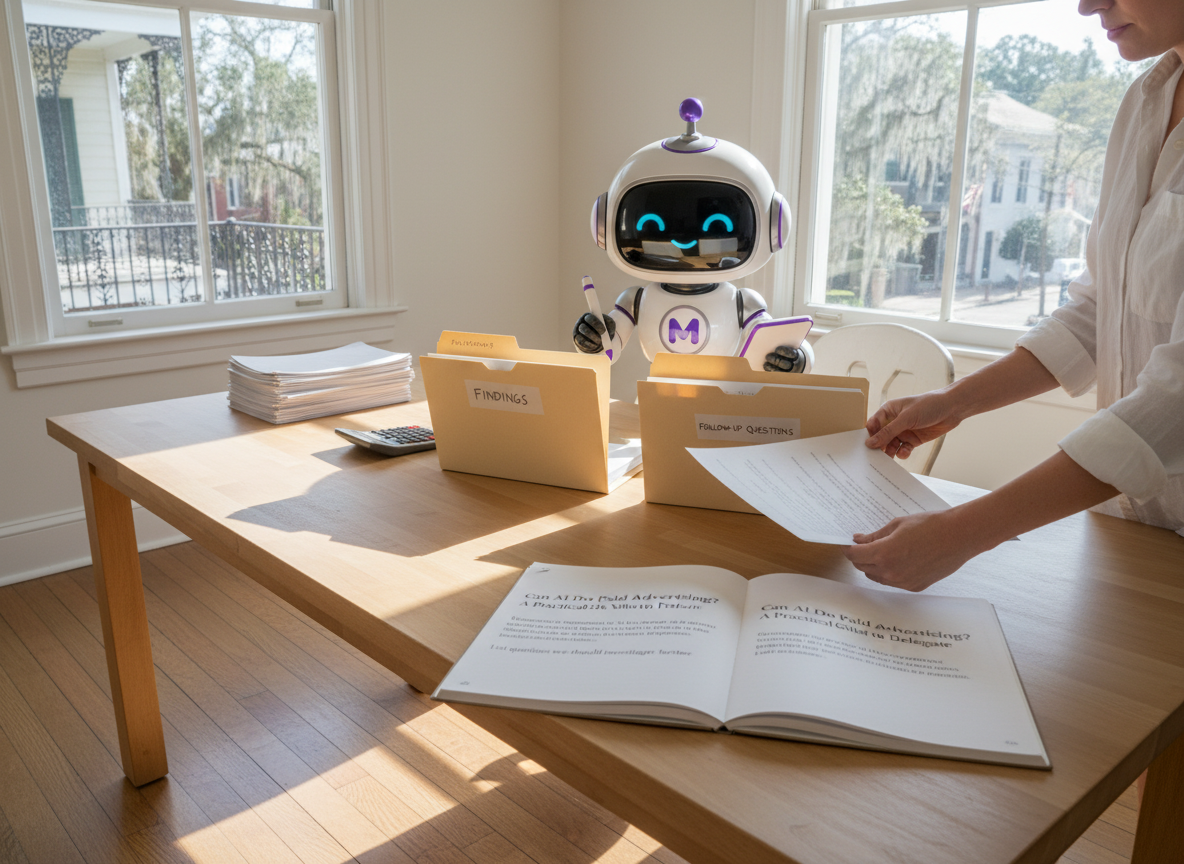
AI can help organize performance information into a readable summary. Give it clearly labeled data and ask it to distinguish observations from possible explanations.
For example:
Summarize what changed in this reporting period. Separate direct observations from hypotheses. List questions we should investigate before changing the campaign.
This is a more disciplined request than asking the tool to declare a campaign successful from a few numbers.
What Should You Keep Under Human Control?
For a practical starting point, reserve approval over five areas.
Business claims. Confirm every statement about services, qualifications, availability, pricing and results before publication.
Budget. Set an explicit spending limit and decide who may authorize changes. Do not use an instruction such as “spend whatever works.”
Customer information. Decide what information may be shared with each tool. Avoid including identifiable customer details when an anonymized example will do.
Publication and account changes. Establish whether drafts, targeting changes and budget adjustments require approval before taking effect.
The definition of success. Choose what the campaign is meant to achieve before reviewing its performance. Do not let the easiest number to report become the objective by default.
AI assistance should make these decisions easier to examine, not remove the need to make them.
What Information Should You Prepare Before Using AI?
Write a short campaign brief before asking for creative work. Include:
The service:
What exactly are you advertising?
The customer:
Who is the message intended to help?
The confirmed coverage:
Where can you actually provide the service?
The objective:
What action should the customer take?
The approved claims:
What may the advertisement truthfully say?
The exclusions:
What must not appear in the copy?
The destination:
Which page will the advertisement lead to?
The budget and approvals:
What limits apply, and who signs off?
Leave unresolved details out of the advertisement until they have been confirmed. If a tool asks for a price or location that has not been approved, do not let it supply a plausible substitute.
How Should You Evaluate AI-Assisted Advertising?
Start with the business objective, then work backward to the information needed to assess it.
If the objective is inquiries, ask how inquiries will be recorded and reviewed. If it is purchases, decide what counts as a completed purchase. Keep the reporting definition consistent enough to make a meaningful comparison.
When reviewing a report, ask:
What happened during this period?
Which conclusions follow directly from the recorded information?
Which explanations are still hypotheses?
What change are we proposing, and why?
Who will approve it, and when will we review it again?
Avoid treating polished commentary as evidence. A useful report should make its reasoning inspectable, including where the information is insufficient to support a decision.
How Does Paid Advertising Fit With Other Marketing Work?
Before paying to send people to a website, review what they will find there. Does the destination page clearly describe the advertised service? Does it support the ad's claims? Is the intended next step obvious?
Marcelo's confirmed services include paid advertising, marketing strategy, website design, content marketing, search engine optimization and social media management. When discussing a project, ask which services belong in the proposed scope and how they relate to the campaign objective.
Keep that discussion specific. Request a clear description of deliverables, responsibilities, approvals and reporting rather than assuming that every service is part of one package.
What Should You Ask Before Hiring an AI-Assisted Advertising Provider?
Use these questions to compare proposals:
- Which tasks will AI assist with?
- Which tools will have access to advertising accounts?
- What can those tools change without approval?
- Who verifies business claims and approves advertisements?
- Who controls the budget?
- What is included in the proposed scope and fee?
- How will performance be assessed?
- What happens if an advertisement contains an error?
For a conversation about Marcelo's paid advertising and related marketing services, email support@meetmarcelo.ai.
Frequently Asked Questions
Can AI run paid advertising completely on its own?
Some tools support automated advertising actions, but their capabilities depend on their integrations and permissions. Do not assume that an AI writing tool can launch or manage campaigns. Establish spending limits, approval rules and responsibility before enabling account access.
Can AI write advertisements for my business?
Yes. Give it approved business information, a defined audience and a clear objective. Review every draft for accuracy before publishing it.
Does using AI guarantee better advertising results?
No. Treat AI as assistance, not a performance guarantee. Define the objective, review the work and assess the campaign using relevant information.
What is the best first step?
Prepare a campaign brief and start with a limited task, such as drafting ad variations for review. Expand the workflow only after responsibilities, permissions and approval steps are clear.
Does Marcelo offer paid advertising?
Yes. Paid advertising is one of Marcelo's confirmed services, alongside marketing strategy, website design, search engine optimization, content marketing and social media management.