 MarceloBlog
Can AI Do Social Media Management?

Yes—AI can help with social media management, particularly planning content, developing draft posts, and preparing material for review. The useful distinction is between helping produce content and taking responsibility for what a business publishes. Treat AI as an assistant within a managed process, not as permission to skip fact-checking, approval, or oversight.
For a business deciding how to use AI, start with this question: which tasks should AI help prepare, and which decisions should remain with an accountable person?
Marcelo offers social media management, content marketing, and marketing strategy. Its social media work includes a content calendar with posts marked as drafted, approved, or published, as well as visual-content review before scheduling. That separation between preparation, approval, and publication is a useful model for evaluating an AI-assisted approach.
What Parts of Social Media Management Can AI Help With?
Think about social media management as a sequence of tasks rather than a single activity. Decide where assistance would be useful, then define the review required before moving to the next stage.
Planning topics

Use AI to help organize ideas around information your business has already approved. A practical planning brief might include:
- The services you want to discuss.
- Questions customers regularly ask.
- The audience for each post.
- The purpose of the post, such as explaining a service or inviting an inquiry.
- Statements, offers, or topics that must not appear.
Ask for proposed topics before requesting finished captions. Review the direction first, rather than polishing posts you do not want to publish.
Preparing drafts

AI can assist with draft captions and alternative wording. Keep the task bounded: provide the source material, explain the intended message, and request a draft that stays within those facts.
For example, a useful instruction would be:
“Draft a social post explaining this approved service description. Keep the tone clear and helpful. Do not add prices, promises, customer quotes, or service locations.”
Judge the draft against the source material—not just whether it sounds polished.
Organizing content for review

Keep proposed content separate from approved content. For each post, record its topic, draft text, visual, reviewer, status, and intended publication date.
Marcelo's social media management work includes a week of scheduled posts for a restoration client, with each post marked as drafted, approved, or already published. Use that kind of status separation as a planning principle: a completed draft should not automatically become a published post.
Developing visual-content ideas

AI assistance can also be considered during visual planning. Begin with a brief describing what the visual should communicate, then review the resulting material alongside the caption.
Check the complete post. Does the image imply an outcome the text does not support? Does it show wording, an offer, or a detail that needs correction? Would a customer reasonably interpret it as evidence of actual work?
Marcelo's social media work includes reviewing and approving visual content before it is scheduled to the feed. Preserve that approval step in any AI-assisted workflow.
What Should a Person Still Review?
Before publishing, assign a person responsibility for checking accuracy, meaning, and suitability. Do not use “the AI wrote it” as an approval standard.
Business facts

Check every statement about services, contact details, locations, availability, pricing, qualifications, and offers against approved business information. Remove any detail that cannot be verified.
A useful editing rule is: if a sentence introduces a new business fact, identify its source before approving it.
Promises and implications

Review more than literal wording. Ask whether the post implies a guarantee, a typical result, an endorsement, or an experience that the business has not established.
Pay particular attention to phrases such as “always,” “guaranteed,” and “the best.” Replace unsupported promises with a clear explanation of the service or a straightforward invitation to get in touch.
Customer information
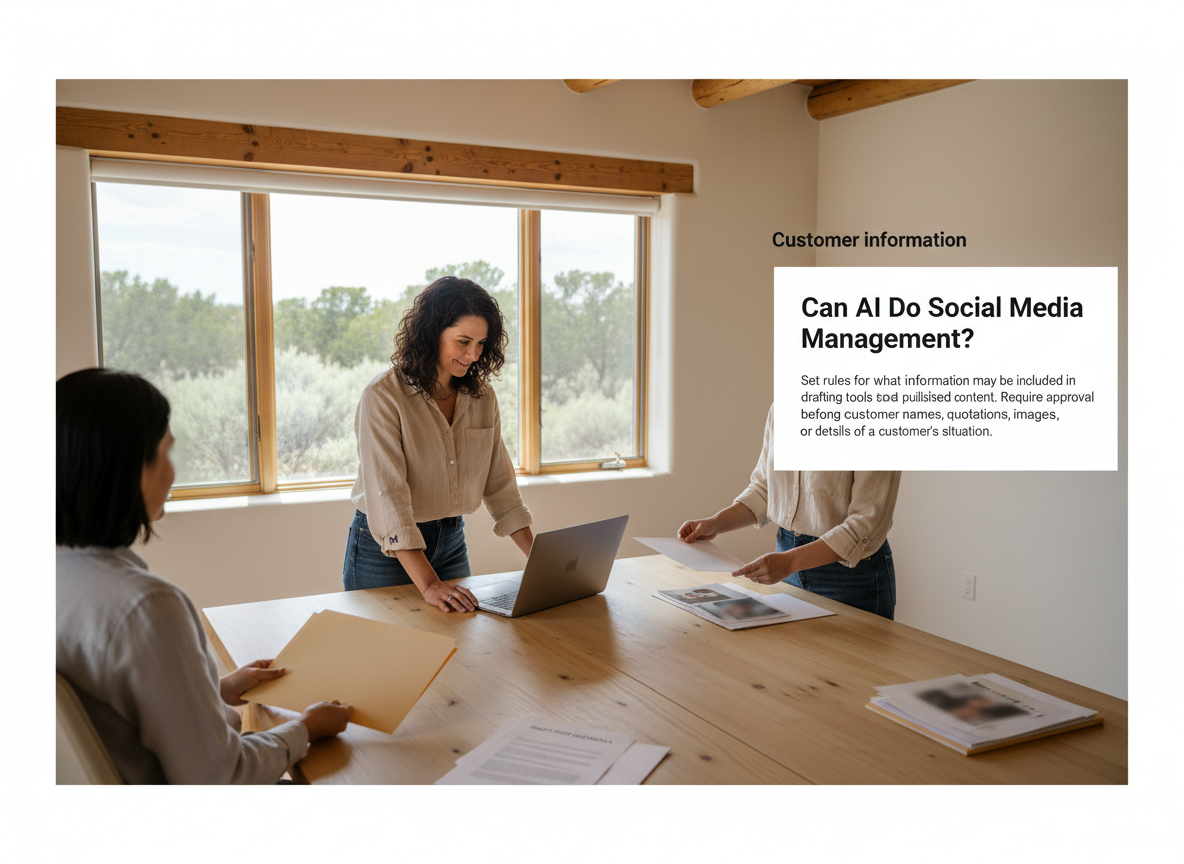
Set rules for what information may be included in drafting tools and published content. Require approval before using customer names, quotations, images, or details of a customer's situation.
Replies and sensitive conversations

Keep a clear escalation route for complaints, disputes, private account questions, and requests involving sensitive information. A suggested reply should remain a draft until an authorized person has reviewed the situation.
Does AI Content Creation Mean Automatic Scheduling and Publishing?
No. Treat drafting, approval, scheduling, and publication as separate steps when choosing a workflow.
Before selecting a tool or service, ask:
- Does it prepare drafts, publish posts, or both?
- Who must approve a post before it is scheduled?
- Can the approver review the caption and visual together?
- How are requested changes handled?
- Who can pause or remove scheduled content?
- Who is responsible for checking the published post?
Do not assume that a tool's ability to write a caption establishes how it handles approval or publishing. Evaluate those functions individually.
How Can You Keep AI-Assisted Posts Useful Rather Than Generic?
Start with a specific customer question and an approved answer. Give the post one job.
For an educational post, use a simple structure:
Question:
What does the customer want to understand?
Answer:
What can the business explain accurately?
Practical detail:
What should the reader consider or do next?
Next step:
Is there a relevant reason to contact the business?
Avoid asking for a large batch of posts from only a business name and a broad industry label. Instead, provide the service description, intended audience, approved facts, and boundaries for each topic.
During editing, ask: “Could another business publish this unchanged?” If the answer is yes, look for a more specific customer question or a clearer explanation—not an invented detail.
What Does a Practical AI-Assisted Workflow Look Like?
Use a repeatable process with a clear handoff at each stage:
1. Establish the brief. Choose the topic, audience, purpose, approved facts, and desired next step.
2. Prepare the draft. Use AI assistance where appropriate, keeping the draft tied to the brief.
3. Review the substance. Check factual statements, implied promises, tone, and the relationship between the caption and visual.
4. Approve the complete post. Record approval of the version intended for publication, including any visual content.
5. Schedule approved material. Keep draft and approved statuses distinct.
6. Review publication and responses. Assign responsibility for checking the published content and handling questions or concerns.
Marcelo's social media examples show planning, status tracking, and visual approval in practice. Its content marketing and marketing strategy services are also relevant when considering how social posts fit into a broader marketing plan.
How Should You Evaluate AI-Assisted Social Media Management?
Evaluate the process, not just the volume of content proposed.
Ask a prospective provider to explain who supplies the facts, who reviews drafts, who approves visuals, and who takes responsibility when a correction is needed. Request a clear distinction between content preparation and ongoing account management.
Also define what you want the work to accomplish before deciding how much to publish. Use that objective to review topics and reporting, rather than treating the number of generated captions as the main measure of value.
The practical answer is not simply “use AI” or “avoid AI.” It is to choose specific tasks for assistance and keep clear responsibility for every published message.
To discuss social media management, content marketing, or marketing strategy with Marcelo, email support@meetmarcelo.ai.
Frequently Asked Questions
Can AI run social media without human review?
For a business account, keep human approval between draft creation and publication. Assign responsibility for factual accuracy, visual content, customer information, and sensitive replies.
Is AI-generated content ready to publish immediately?
Treat it as a draft. Check it against approved business information, review the complete caption and visual, and approve the final version before scheduling.
Should every social post be written with AI?
Choose assistance task by task. Establish the purpose and source material first, then decide whether AI would be useful for planning, drafting, or editing that particular post.
What should I ask a social media management provider about AI?
Ask where AI is used, what information it receives, who reviews its output, how approval works, and who handles corrections and customer replies.
Does Marcelo offer social media management?
Yes. Marcelo offers social media management, along with content marketing, marketing strategy, search engine optimization, website design, and paid advertising.