 Marcelo
Free AI Tool for Paid Advertising: What Should You Choose?

If you want a free AI tool for paid advertising, start by checking whether its no-cost access covers your actual task: planning a campaign, developing ad copy, or reviewing an existing draft. Choose around that task rather than a long feature list, and evaluate the tool’s access terms separately from the money you intend to spend on advertising.
What do you need the AI tool to help you do?
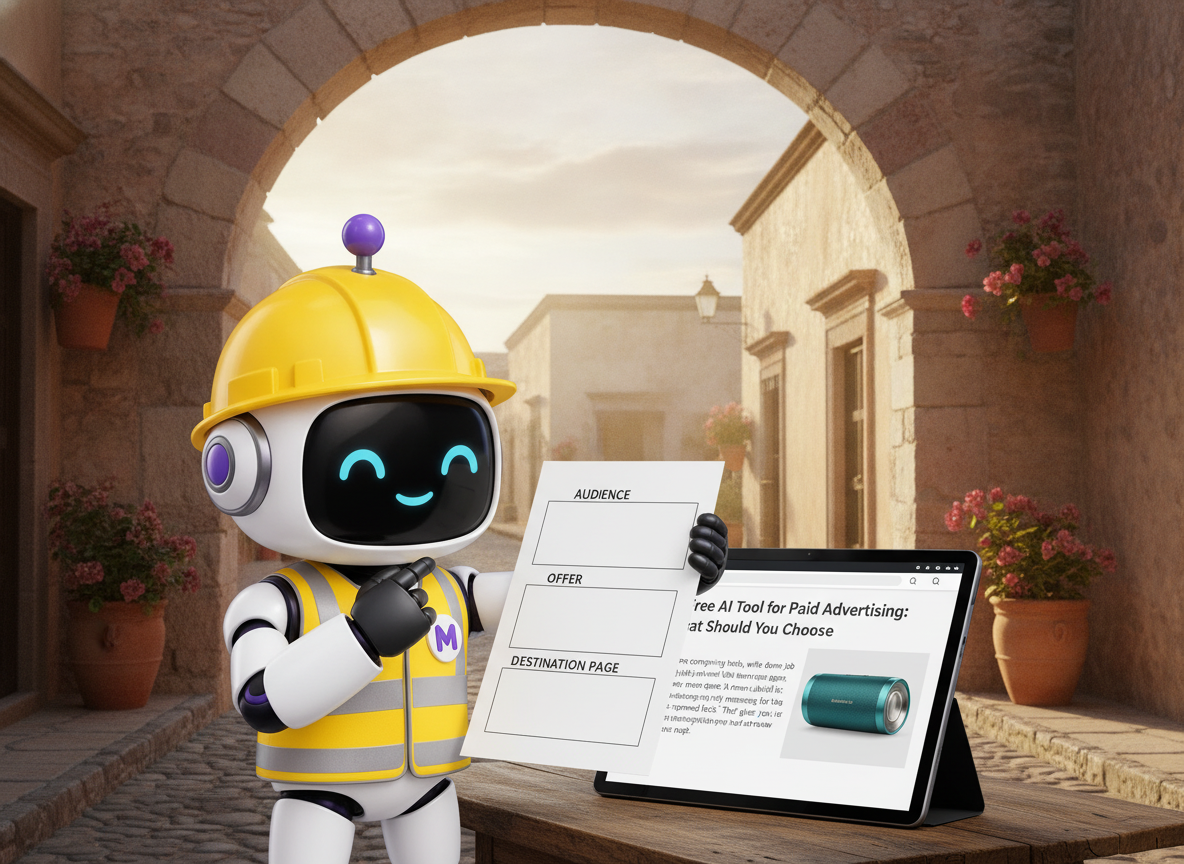
Before comparing tools, write down the job you want help with. “Help me with paid advertising” leaves too much open. A more useful brief is: “Help me develop three ad messages for this service, using only these approved facts.” That gives you a clear task and a straightforward way to review the output.
Use these categories to narrow your search. Treat them as capabilities to check, not features to assume any particular product includes:
Campaign planning
Look for help organizing your objective, intended audience, offer, and destination page into a clear brief.
Ad writing
Look for a way to develop distinct draft messages from information you supply.
Draft review
Look for help identifying unclear wording, unsupported claims, or a mismatch between the ad and its destination page.
Choose one starting task. If your offer is still unclear, work on the brief before requesting headlines. If you already have an approved brief, focus your evaluation on whether the tool follows it accurately.
How should you check whether an AI tool is really free?

Read the access and pricing terms before building your workflow around a tool. Check whether the offer is ongoing no-cost access, a time-limited trial, or access restricted to selected functions. Also check whether the task you need requires a paid upgrade.
Keep your evaluation specific. Can you complete a useful draft within the stated limits? Can you retain your work? Are payment details required? What happens when the trial or allowance ends? Record the answers so you can compare options on the same basis rather than relying on the word “free.”
Evaluate software access and your advertising budget as separate decisions; check the terms for each before committing.
What information should you give an AI tool?
Prepare a short, approved source brief before asking for advertising ideas. Include what you offer, who the message is intended for, what action you want the reader to take, and the page the ad should lead to. Add prices, locations, credentials, or promotional terms only when you can verify and approve them for use.
Give the tool explicit boundaries as well as creative direction. For example: “Use only the facts below. Do not add prices, guarantees, testimonials, qualifications, locations, or performance claims. If a detail is needed, ask for it.” Review the result against the brief rather than treating those instructions as a replacement for checking.
Ask for a small number of meaningfully different approaches. You might request one draft centered on the customer’s question, one explaining the offer plainly, and one emphasizing the next step. Compare the ideas before asking for more variations; avoid spending your review time on nearly identical wording.
How can you test a tool before using its output?
Use a limited exercise with approved information. The aim is to judge the tool’s usefulness for your task—not to accept a polished-looking draft as publication-ready. Follow the same review process for each option you evaluate.
Set one task
Ask for a small set of ad drafts based on a single approved brief.
Check factual accuracy
Compare every claim with your source material and remove anything unsupported.
Review the message
Check whether a reader can understand the offer and the requested next step.
Check the destination
Make sure the proposed ad accurately describes what the linked page presents.
Review publication requirements
Check the intended advertising platform’s current rules and format requirements before using the draft.
Choose or revise
Keep only the material you can approve, and record what still needs human judgment.
If you later run a campaign, decide in advance what you will evaluate. Choose a measure that fits your objective, such as completed inquiries or purchases, rather than judging the tool solely by how persuasive its writing sounds. Keep draft quality and campaign outcomes as separate review questions.
Where does Marcelo fit into paid advertising work?
Marcelo is software you use online, with offerings that include paid advertising, AI tools, marketing strategy, search engine optimization, content marketing, social media management, and website design. Approach it as software to use yourself, rather than an agency you hire to carry out a campaign.
Start with the advertising task you have defined. When evaluating Marcelo, check the available functions and access terms against that task, just as you would with any other option. Keep your approved brief and review checklist alongside you so your choice stays focused on what you need to accomplish.
Frequently asked questions
What should I compare besides the price?
Compare how well each tool follows your brief, how much correction its drafts need, and whether its access limits suit your intended use. Include the time you spend reviewing and revising when deciding whether a tool is useful to you.
Should I publish AI-written ads without editing them?
Review them first. Check factual claims, offer terms, destination-page consistency, and the intended platform’s current requirements. Approve only wording you are prepared to publish under your business’s name.
Do I need an AI tool that launches ads automatically?
Not necessarily. If your immediate task is developing a brief or reviewing copy, evaluate that task first. Consider publishing functions separately, and check how approval, account access, and spending controls work before using them.
To explore Marcelo’s paid advertising and AI tools, get started on Marcelo’s website.